
Finishes and textures in shoe molds: technical precision and aesthetic quality
The shoe mold finishes They contribute to the aesthetic quality of the component, along with the dimensional accuracy and reliability of the mold. The mold not only determines the shape, but also transfers the surface characteristics defined during the design process to the product.
Textures, decorative patterns, matte or glossy surfaces and graphic details depend on the quality with which the mold surface is prepared and worked.
For this reason, especially in the sectors fashion, luxury, sport and lifestyle, Finishes must be considered from the earliest stages of development. They aren't a purely aesthetic intervention, but an integral part of the mold's technical design and the final result of the shoe.
Shoe mold finishes: when the mold surface becomes part of the design
The mold's surface helps define the finished component's appearance. A texture can characterize a specific area of the shoe; a glossy surface can produce a very different visual effect than a matte finish; patterns, engravings, and details can make a model or product line recognizable.
The mould processing must therefore allow for reproduce the project accurately and maintain the result consistent throughout production.
This requires attention not only to the overall geometry of the component, but also to the smallest elements, such as:
- depth and definition of textures;
- edge precision;
- uniformity of surfaces;
- continuity of motifs;
- transitions between areas with different finishes.
The aesthetic quality of the product also depends on the ability to control these details and repeat them uniformly on all molds intended for the same production.
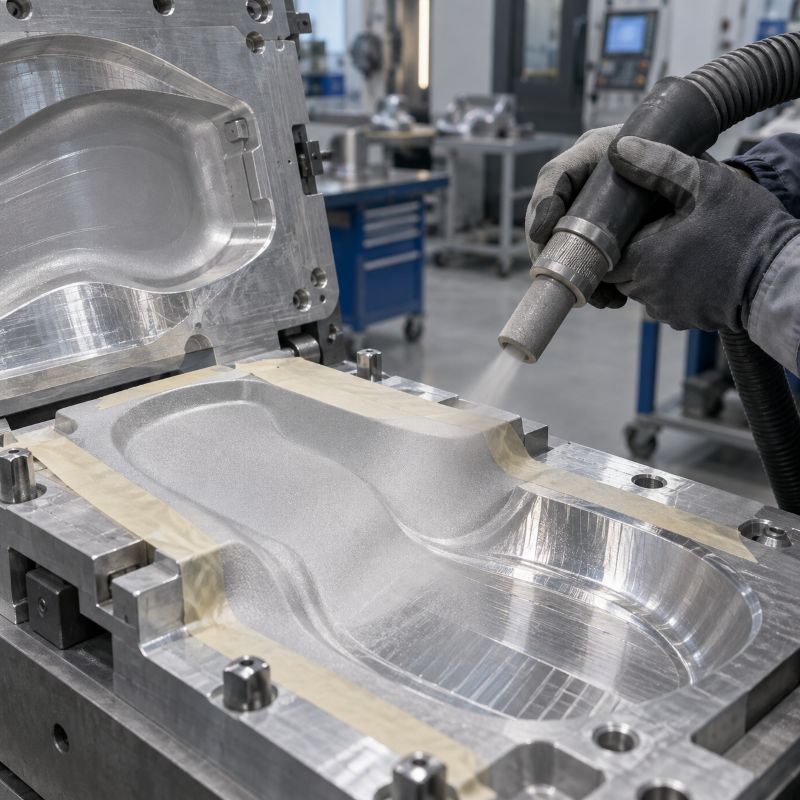
Sandblasting of molds
There sandblasting allows you to work on the surface of the mold to obtain a uniform and controlled finish.
Depending on the characteristics required by the project, it can be used to modify the appearance of the surface and contribute to the creation of specific effects on the final component.
The choice of processing parameters must take into account the mold geometry, the size of the affected areas, and the required level of uniformity. This consideration becomes particularly important when surfaces with different characteristics must coexist within the same component.
It is also necessary to precisely define the boundaries between the different areas, so that the transition from one finish to another is consistent with the original design.
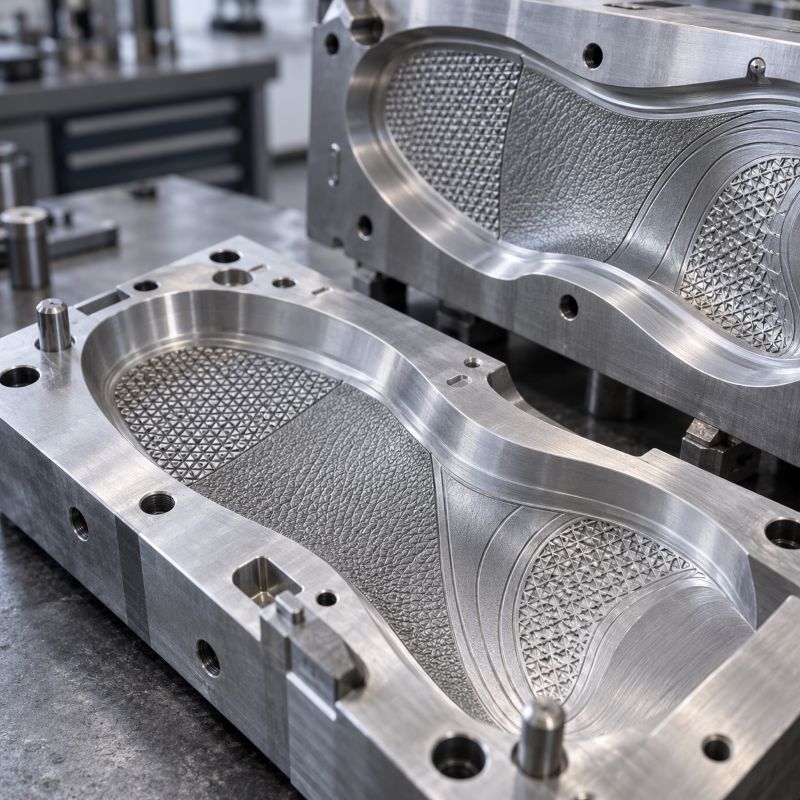
Textures and surface treatments
The textures applied to the mold They allow for the creation of complex surface patterns and finishes, expanding the possibilities for aesthetic customization of the footwear.
Patterns and details defined during product development must be precisely reproduced on the mold surface. Particular attention is paid to their repeatability, which is essential to ensure a consistent result across all molds used in the same production run.
The texture definition must reconcile the desired aesthetic effect with the technical requirements of the molding process. Geometry, depth, orientation, and surface characteristics are therefore evaluated in relation to the material being processed and the desired result.
The position of the texture on the component is also crucial: the same pattern can behave differently on a flat, curved or complex geometric surface.
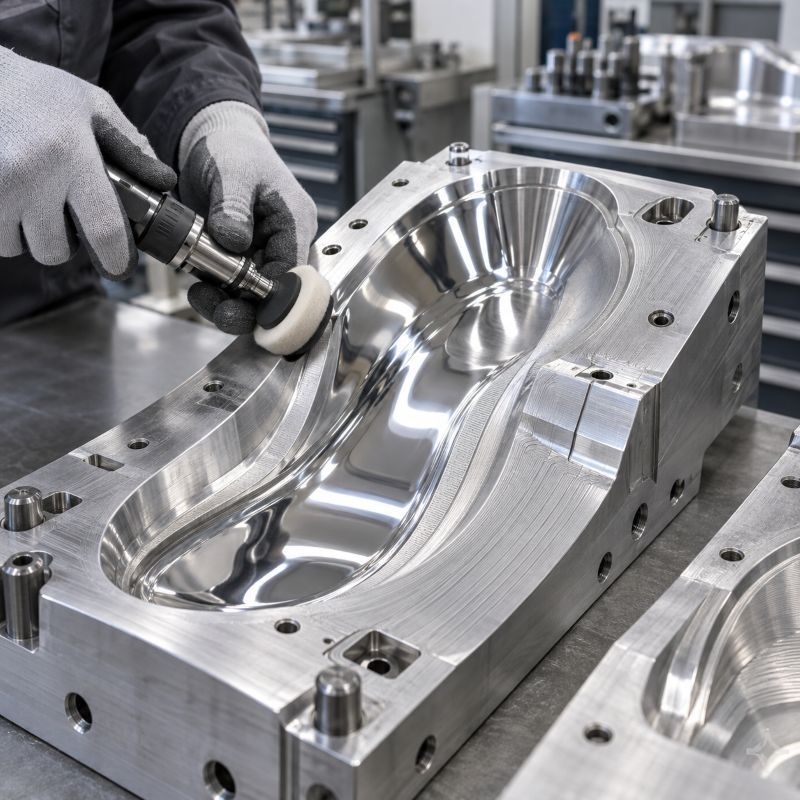
Mirror polishing
When the project requires particularly smooth and shiny surfaces, the mold can be subjected to mirror polishing.
This is a process that requires careful control of the surface, as any irregularities or imperfections in the mold may become visible on the produced component.
The result depends on the quality of the preparation, the uniformity of the workmanship, and the attention paid to the various areas of the mold. Polishing must also be compatible with the component's geometry, the material used, and the aesthetic effect intended by the project.
It is therefore not an isolated finish, but a process to be evaluated within the entire mold making process.
Textures and details for fashion and luxury footwear
In the fashion and luxury sectors, even seemingly secondary elements contribute to the perceived quality of the footwear.
The surface of a component can become an integral part of the product's design language through custom textures, surface effects, decorative patterns, logos and distinctive details.
The mold maker's task is to translate these aesthetic indications into a technically feasible solution, compatible with the production process and consistently reproducible.
It is precisely in the transition from design to industrial production that experience in shoe mold construction takes on a decisive role: the detail must retain its aesthetic identity without compromising the mold's functionality and the continuity of the result.
Finish, geometry and material: an integrated evaluation
The finish cannot be defined independently of the other elements of the mold.
The result is in fact born from the interaction between component geometry, material used, manufacturing process and surface characteristics. The same texture may require different solutions depending on the material to be printed, the depth of the design, or the geometry on which it must be reproduced.
It is also necessary to consider the behavior of the material inside the mold, the ability to correctly fill the details and the ejection requirements of the component.
For this reason, surface definition must be integrated into the mold design and not simply considered a final step. Addressing these aspects from the outset allows us to verify the feasibility of the solution and maintain the right balance between aesthetics, functionality, and production repeatability.
From mold design to detail quality
Padana Stampi designs and manufactures aluminum molds for the footwear sector, following the various phases necessary to transform the customer's project into a tool intended for production.
The ability to modify surface finishes allows us to meet both the technical and aesthetic needs of the various footwear market segments, creating molds characterized by geometric precision and attention to detail.
From sandblasting to texture creation and polishing, each process is evaluated based on the mold's geometry, the material used, the production process, and the desired end result.
Because, in the production of a shoe, the quality of the detail also comes from the mold.